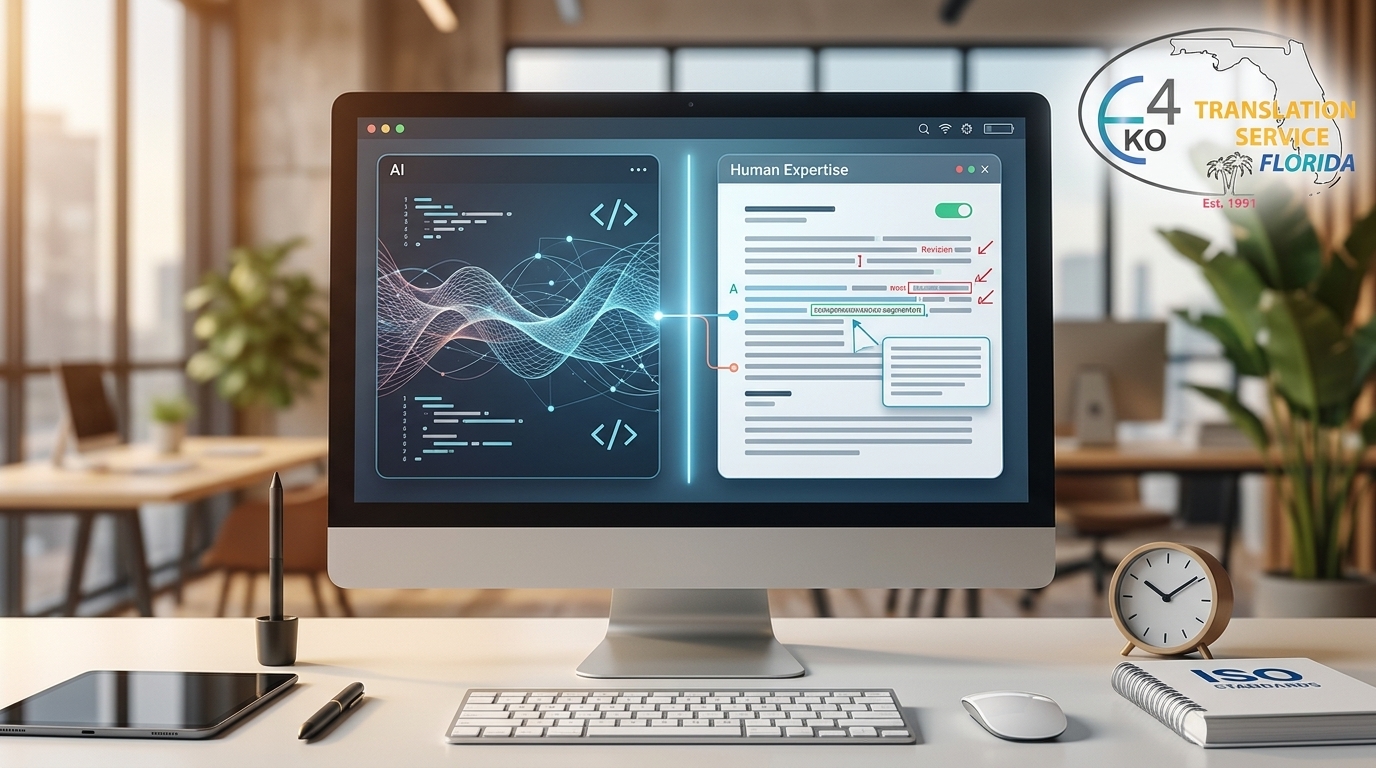

As we navigate the midpoint of 2026, the linguistic landscape is undergoing a profound transformation. The conversation has shifted from the mere capabilities of artificial intelligence to the indispensable role of the human expert. In June 2026, the most significant trend redefining translation industry quality standards is the move toward “Human-in-the-Loop” (HITL) workflows and the adoption of the “Time to Edit” (TTE) metric. This shift reflects a maturing market that recognizes that while AI can generate text quickly, only certified human professionals can guarantee the legal and cultural nuances required for official use.
This month, two major industry events set the tone for this evolution. The NAJIT 47th Annual Conference, held from June 5–7, 2026, in Atlanta, GA, centered on the theme “Beyond AI: The Irreplaceable Human Element.” This sold-out event brought together the nation’s leading judiciary interpreters and translators to discuss the risks of over-reliance on machine translation in high-stakes environments. Simultaneously, the ATA-FIT Standards Symposium on June 18, 2026, focused on shaping a regulatory framework for generative AI, emphasizing that quality is now measured by how effectively a human professional can refine and certify technical content. For clients of EKO 4 Translations Florida, these developments signal a new era where accuracy is backed by rigorous, standardized human oversight.
For years, the industry relied on subjective markers like “fluency” or “readability” to judge translation quality. However, in June 2026, the professional community has officially pivoted to Time to Edit (TTE) as the gold standard for efficiency and quality. TTE measures the exact duration a human expert requires to bring a machine-assisted translation up to a publishable, certified standard. A lower TTE suggests a high-quality initial draft, but a consistently applied TTE process ensures that no document is delivered without a thorough human audit.
This metric is particularly relevant for a translation agency handling complex legal, medical, and technical files. When the TTE is high, it indicates that the automated portion of the work failed to capture the nuances of the source text, necessitating a complete manual rewrite. At EKO 4 Translations Florida, we have integrated TTE benchmarks into our internal quality control to ensure that every project—regardless of the underlying technology—meets the highest possible threshold of human precision.
The administrative side of the industry is also seeing increased scrutiny from federal authorities. Reports from early June 2026 indicate that USCIS is strictly enforcing 8 CFR 103.2(b)(3), with a notable increase in “Requests for Evidence” (RFEs). These RFEs are frequently triggered not by translation errors themselves, but by technical non-compliance in the certification block. Specifically, translators are now required to explicitly state their competencies and adhere to rigid formatting standards that many automated tools cannot replicate.
This regulatory environment makes the choice of a certified provider more critical than ever. Whether you are dealing with federal immigration authorities or state-level courts, the requirements for certified translation have become more prescriptive. EKO 4 Translations Florida stays ahead of these changes by participating in state-level orientation programs, such as the new Florida court interpreter training sessions launched in early June to address shortages in Spanish, Haitian Creole, and Portuguese. By aligning our practices with both federal standards and the latest translation industry quality standards, we protect our clients from avoidable administrative delays.
Another emerging trend this month is “hyper-localization.” While AI struggles with regional dialects and local regulatory nuances, human translators are specializing in adapting content for specific communities. In Florida, this means moving beyond general Spanish or Portuguese to address the specific linguistic needs of the state’s diverse population. The Association of Translators and Interpreters of Florida (ATIF) recently highlighted this at the “Elévate 2026” conference in Miami, where experts discussed the integration of AI in regional services without losing the local “flavor” that ensures clear communication.
While technology speeds up certain parts of the industry, the administrative infrastructure is currently facing significant hurdles. As of June 12, 2026, the Florida Department of State (Division of Corporations) is reporting a three-to-four-week backlog for mail-in apostille requests. On the federal level, the U.S. Department of State Office of Authentications in Washington, D.C., is reporting critical delays of up to 10–12 weeks for standard mail-in apostille services.
In response to these delays, EKO 4 Translations Florida provides essential support through expedited courier channels. For those who cannot afford to wait months for federal or state authentication, professional intervention is no longer a luxury—it is a necessity. Our agency bridges the gap between the modern, fast-paced digital world and the often-slow administrative processes of government bureaus. If you are facing a tight deadline, you can obtain a free estimate for our rush services, which include same-day translation options and expedited document handling.
As the industry moves toward a “Human-in-the-Loop” future, EKO 4 Translations Florida remains at the forefront of these technological and regulatory shifts. We don’t just provide translations; we provide a governor of quality in an increasingly automated world. By adopting the latest translation industry quality standards, such as TTE and adaptive machine translation that learns from our human editors in real-time, we ensure that our clients receive the fastest possible turnaround without sacrificing the accuracy that their legal and personal matters demand.
The role of the translator in June 2026 has evolved into that of a high-level editor and compliance expert. As federal agencies and state courts increase their standards for language access, having a partner like EKO 4 Translations Florida ensures that your documentation is not just translated, but fully authenticated and accepted by the relevant authorities. In an era where AI is everywhere, the human element remains your greatest asset for precision and peace of mind.