
As we move into July 2026, the administrative landscape for the translation and interpreting industry is undergoing a significant transformation. From professional credentialing to high-level judicial mandates, the focus has shifted toward ensuring absolute accuracy in high-security and legal settings. Central to this shift are the updated court interpreter standards, which have recently been reinforced by new administrative orders in the state of Florida and broader discussions at national conferences.
The industry is no longer just about converting words from one language to another; it is about navigating a complex web of regulatory compliance and technological integration. For agencies like EKO 4 Translations Florida, staying at the forefront of these changes is essential to providing the certified translation and interpreting services that Florida residents and businesses depend on. Whether you are navigating a legal matter in the 17th Circuit or managing international corporate expansion, understanding these new standards is critical to ensuring your documentation meets current legal thresholds.
Florida has always been a leader in language access, but 2026 has brought about more stringent requirements for linguistic professionals working within the state’s judicial system. Specifically, Florida’s 17th and 18th Circuits have issued Administrative Order 2026-11-Ge, which reaffirms the mandatory appointment of certified interpreters for all “fundamental interest” cases. This order highlights a growing tension in the court interpreter standards: while the demand for certified Spanish and Creole interpreters continues to surge, there is a notable shortage in rural counties.
To address this, the courts are increasingly relying on “Provisionally Approved” designations. However, these designations come with strict oversight to ensure that the quality of interpretation does not falter. For the broader industry, this means that professional translation agencies must be more diligent than ever in vetting their linguists. At EKO 4 Translations Florida, we align our internal protocols with these judicial standards, ensuring that every project—whether intended for a courtroom or a government agency—is handled by professionals who understand the weight of these administrative requirements.
For those requiring document preparation that aligns with these rigorous standards, you can easily order your translation online through our secure portal, ensuring compliance with the latest Florida judicial norms.
The National Association of Judiciary Interpreters and Translators (NAJIT) recently concluded its 47th Annual Conference in Atlanta in June 2026. This sold-out event served as a focal point for the industry, setting the tone for the second half of the year. One of the most discussed topics was the “Evolving Role of Judiciary Interpreters” in an era of rapid technological change. A key takeaway was the introduction of specialized training tracks for investigative transcription—a field that requires a unique blend of linguistic expertise and forensic attention to detail.
The conference also highlighted the increasing use of remote interpreting technology in high-security settings. As the global translation services market is projected to reach $28.86 billion by the end of 2026, the industry is moving away from generalist approaches and toward hyper-specialization. This shift was mirrored at the ATA Nexus 2026 event, where the debut of “Lara”—a purpose-built translation model designed specifically for legal and medical precision—showcased a departure from general-purpose AI tools like ChatGPT.
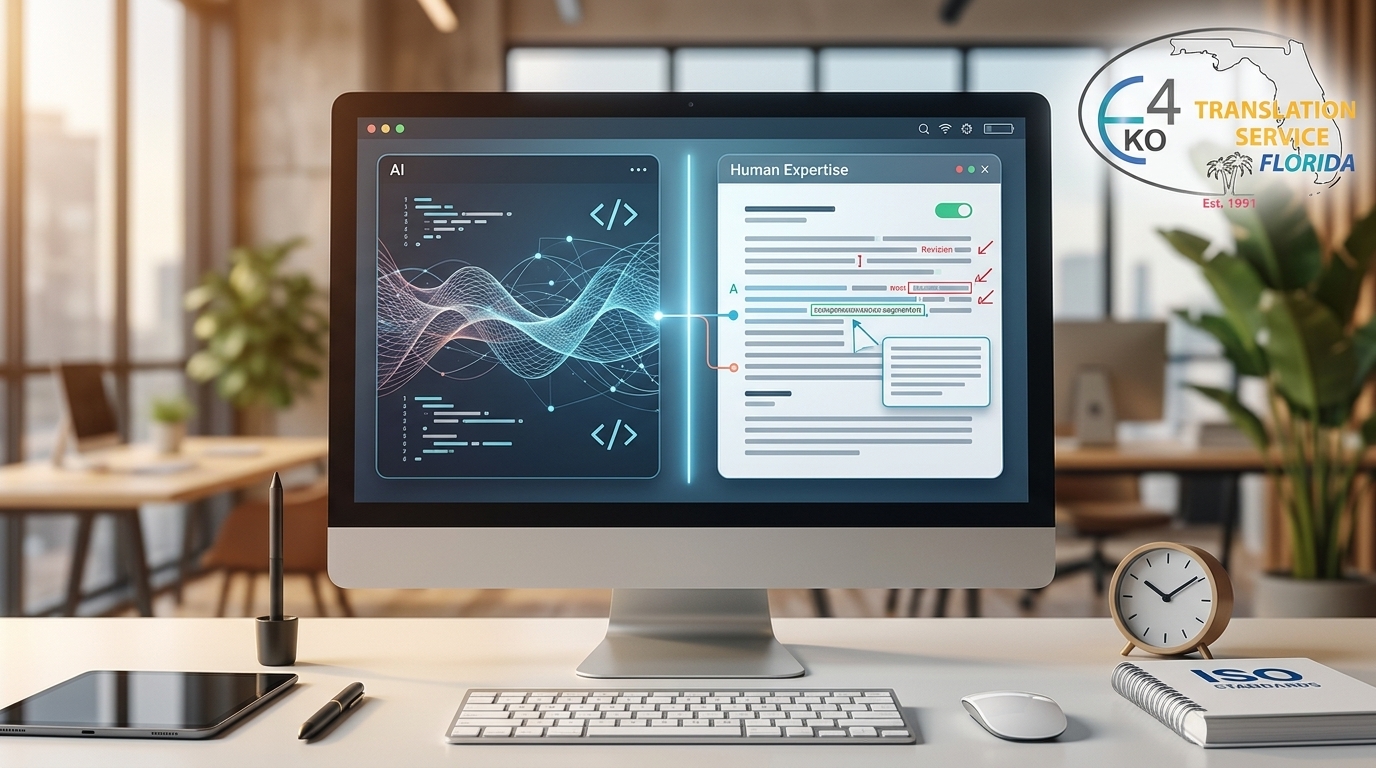
One of the most profound shifts in 2026 is the industry’s response to AI. While artificial intelligence has become a tool in the linguist’s belt, the American Translators Association (ATA) has been vocal about the dangers of “de-professionalization.” Through its new publication, “The ATA Savvy Linguist,” the association is promoting a “Human-in-the-Loop” (HITL) workflow. This is particularly vital in legal and administrative translation, where unverified AI output can lead to significant legal liabilities.
In the context of court interpreter standards, the consensus is clear: while technology can assist with speed, the final “Outcome Metrics” must be verified by a human expert. The industry is moving toward “Time to Edit” (TTE) pricing models, reflecting the value of the human specialist who ensures that the translated text is not just fluent, but legally and culturally compliant. EKO 4 Translations Florida embraces this HITL philosophy, combining the efficiency of modern tools with the nuanced expertise of certified human translators to maintain the highest levels of accuracy.
Beyond Florida, federal initiatives are also reshaping the industry. A bill proposed in the U.S. Congress in early 2026 aims to create a Federal Language Access Board. This board would standardize how federal agencies, such as the Social Security Administration and the Department of Homeland Security, handle translated materials and interpreter qualifications nationwide. This move toward standardization is expected to streamline the process for individuals and businesses dealing with federal documentation.
Furthermore, USCIS (U.S. Citizenship and Immigration Services) has updated its agency guidance under 8 CFR 103.2, emphasizing that electronic signatures on translated documents must be “signed images” or “digital pen signatures.” The common practice of using typed names (e.g., “/s/ John Doe”) is now frequently resulting in Requests for Evidence (RFEs), which can cause significant delays in administrative processing. Navigating these federal nuances requires an agency that is not only proficient in language but also deeply familiar with current administrative regulations.
The complexities of the 2026 market require a proactive approach to language services. As Florida-based agencies increasingly specialize in “Federal-State Hybrid” services, EKO 4 Translations Florida remains a leader by integrating these new court interpreter standards and federal requirements into our daily operations. We understand that whether you are dealing with a local circuit court in Miami or a federal office in D.C., the accuracy of your certified translation is non-negotiable.
Our commitment to the “Human-in-the-Loop” standard means that we provide same-day rush services without sacrificing the professional integrity that the current market demands. If you are unsure how the latest administrative orders or federal signature requirements affect your specific needs, you can obtain a free estimate to understand the scope and compliance requirements of your project.
As the industry continues to evolve toward a valuation of nearly $29 billion, the value of professional certification and expertise has never been higher. EKO 4 Translations Florida continues to advocate for the highest professional standards, ensuring that our clients are always one step ahead of the changing regulatory and technological landscape.