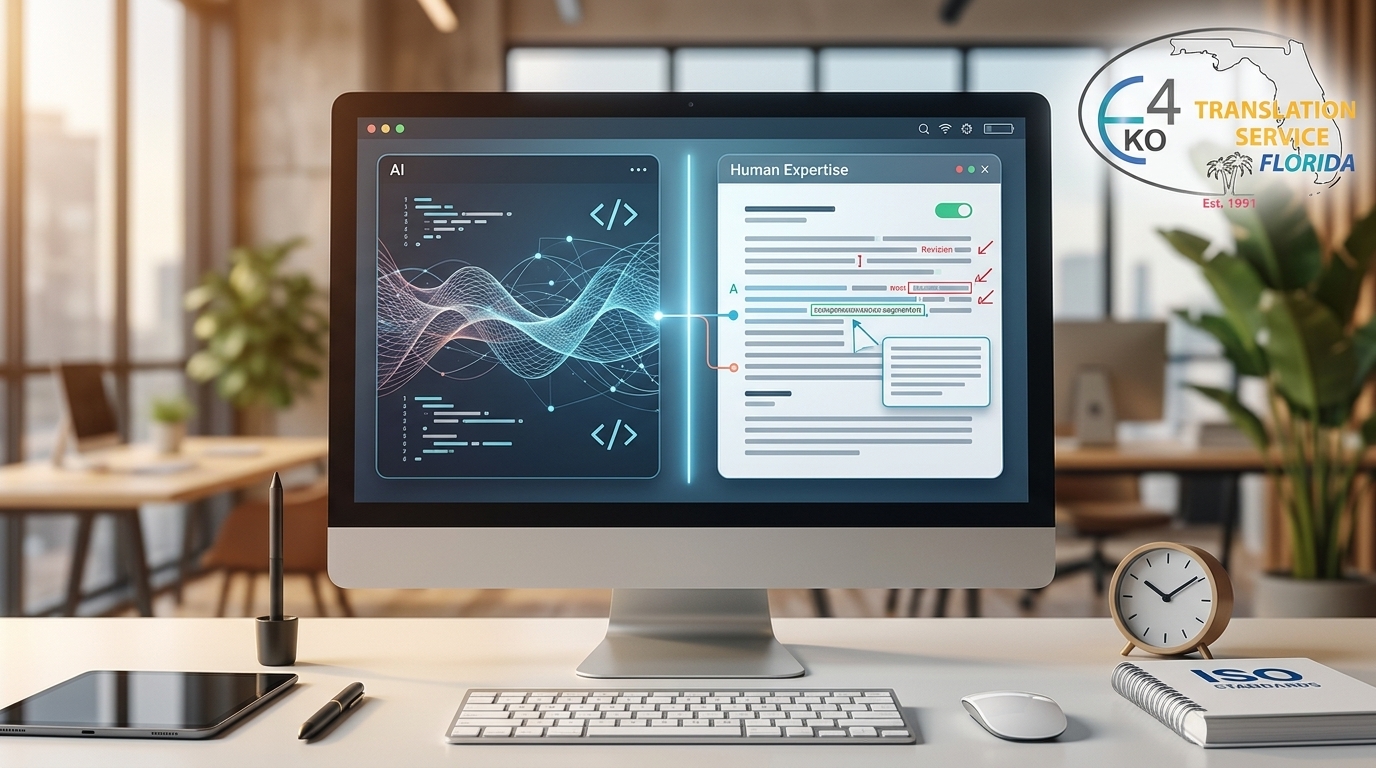
As we navigate September 2026, the language services industry has reached a significant inflection point. The initial wave of artificial intelligence hype has subsided, giving way to a more sophisticated and regulated “maturity phase.” This month, the central focus of the global translation market is the widespread adoption of hybrid AI-human translation workflows, a model that prioritizes purpose-built accuracy over the raw speed of unverified automated output. For businesses and legal professionals in Florida, this shift represents a fundamental change in how high-stakes content is processed and authenticated.
The industry is moving away from the binary choice between “human only” or “machine only” translation. Instead, leading agencies are integrating Large Language Models (LLMs) and Generative AI into a structured, human-led environment. This ensures that while volume can be handled efficiently, the nuances of cultural context, legal terminology, and technical precision are strictly managed by professional linguists. Professional translation services are no longer just about converting text; they are about orchestrating these complex technological workflows to ensure compliance and reliability.
A primary driver of this shift is the highly anticipated revision of the ISO 18587 standard, expected to be finalized by the end of 2026. Historically, this standard focused on Machine Translation Post-Editing (MTPE). However, the September 2026 updates have expanded the scope to explicitly include “non-human translation output,” covering the latest advancements in LLMs and Generative AI. This revision provides a standardized framework for how agencies must document and execute the human-in-the-loop process, ensuring that the final output meets the rigorous quality benchmarks required for official use.
This regulatory movement is not happening in a vacuum. Industry leaders, including those preparing for the American Translators Association (ATA) 67th Annual Conference in San Francisco this October, are emphasizing that technology must serve as a tool for the expert, not a replacement. Early registration for this landmark event, which closed its first phase on September 14, 2026, has seen record numbers, highlighting a professional community eager to master these new hybrid standards. At EKO 4 Translation Service Florida, we have already begun aligning our internal protocols with these evolving ISO benchmarks to provide our clients with the highest level of security and linguistic precision.
The demand for human oversight is also being reinforced by federal and state-level policy changes. Throughout July and August 2026, industry reports indicated a notable trend: USCIS and other federal agencies are increasingly rejecting translations not due to linguistic errors, but because of “procedural gaps.” These gaps often include missing physical signatures or incomplete certification statements that do not strictly adhere to 8 CFR 103.2(b)(3). This underscores the fact that while AI can translate, it cannot provide the legal accountability required for certified translation.
Furthermore, the Language Access for All Act of 2026, which gained significant legislative momentum this month, aims to codify protections for individuals with limited English proficiency (LEP). This federal act mandates standardized access to all federal services, effectively raising the bar for how agencies handle sensitive communications. In Florida, new administrative orders, such as Order 26-05 in the 18th Judicial Circuit, have expanded the requirement for certified interpreters in a broader range of court proceedings. These regulations highlight a growing recognition that “good enough” translation is no longer acceptable in a professional or legal setting.
The Florida language market itself is undergoing a structural transformation. In July 2026, the acquisition of Tampa-based All Languages Specialists, Inc. (ALS) by new executive leadership (Brian Mitchell and Kathryn Denaro) signaled a surge of private investment into the state’s translation sector. This influx of capital is largely directed toward scaling technology-driven services that can handle the massive data volumes of Florida’s legal and healthcare industries while maintaining the human touch necessary for complex cases.
Agencies are also shifting their value proposition from “per-word pricing” to “ROI-driven localization.” This means focusing on how precisely translated content directly correlates with revenue growth and risk mitigation in non-English speaking markets. Whether dealing with legal industry translation services or corporate communications, the emphasis is now on the strategic impact of the translation. To start navigating these new industry standards, you can request a free estimate for your next project.
As the industry navigates these complexities, EKO 4 Translation Service Florida remains at the forefront of the “Beyond AI” movement. We recognize that while technology enables us to work faster, our value lies in the ethical and professional standards we uphold. The recent NAJIT 2026 conference highlighted the irreplaceability of the human element in high-context environments, particularly in judiciary settings where the nuances of intent and tone can alter legal outcomes.
For those requiring rapid turnaround in an environment of increasing state-level backlogs, EKO 4 continues to provide reliable solutions. While the Florida Secretary of State recently implemented a mandatory 24-hour turnaround for third-party apostille services, ending the era of same-day walk-ins, our agency has adapted its logistics to ensure the fastest possible delivery within the new legal framework. We bridge the gap between cutting-edge technology and human accountability, ensuring that every document is not only translated but also correctly certified and notarized for its intended purpose.
The translation landscape of late 2026 is one of balance. By embracing hybrid AI-human translation workflows, we offer our clients the efficiency of the future with the reliability that only an experienced professional can provide. If you are ready to secure your official documents with a partner who understands these evolving global and state standards, you can order your translation online today and experience the EKO 4 difference.