
Losing a loved one is an emotionally taxing experience, and the subsequent administrative hurdles can often feel overwhelming, particularly when those matters involve international jurisdictions. In our increasingly globalized world, it is common for individuals to hold assets, property, or family ties in different countries. When a death occurs in Florida, but the legal effects must be felt abroad—such as for settling an estate, claiming life insurance, or repatriating remains—the state-issued document requires a specific form of international validation.
Obtaining an Apostille of death certificate is the standardized process used to verify the authenticity of a public official’s signature on the document for use in countries that are members of the Hague Apostille Convention. As of October 2026, the procedural landscape for these certifications in Florida involves specific state-level requirements that must be followed precisely to avoid delays in sensitive legal matters. At EKO 4 Translation Service Florida, we understand the urgency and delicacy of these situations, providing comprehensive support for both the authentication process and the necessary subsequent translations.
The need for an apostille typically arises when a foreign institution needs to verify that the Florida death certificate is a genuine legal document. In late 2026, several primary scenarios drive the demand for this service:
For many of these legal processes, specifically within the European Union and Latin America, the receiving institution will also require a death certificate translation into the local language. EKO 4 Translation Service Florida provides these specialized services to ensure that your paperwork meets the exact standards of foreign consulates and courts.
In the State of Florida, the authority to issue an apostille rests solely with the Florida Department of State, specifically the Division of Corporations located in Tallahassee. It is a common misconception that a local notary or a county clerk can issue an apostille; they can only notarize or certify the document, but the final international seal must come from the state level.
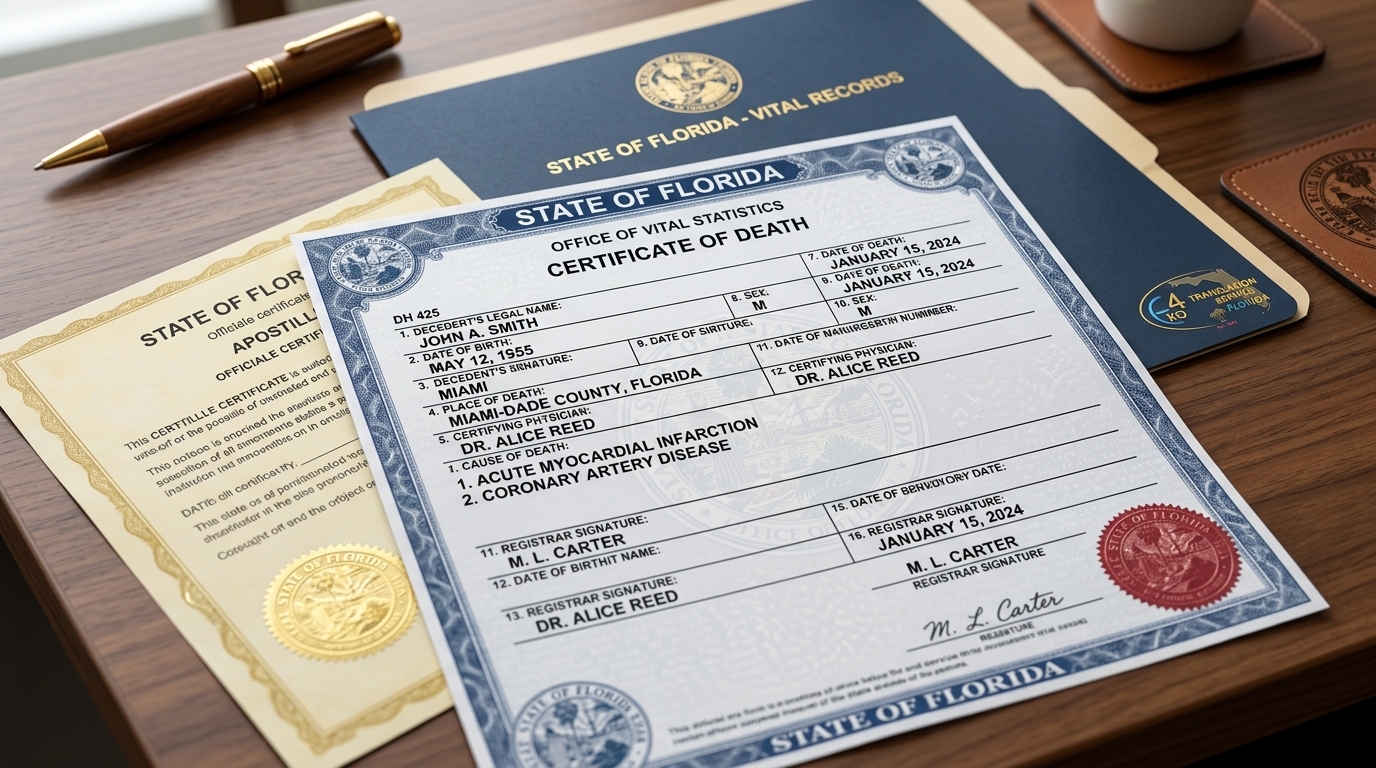
To successfully obtain an apostille, you must submit an original certified copy of the death certificate. This document must be issued by the Florida Bureau of Vital Statistics or a Florida County Health Department. Crucially, the record must bear the signature of the State Registrar (currently Ken Jones). Documents signed by a local attending physician, a funeral director, or a medical examiner are not eligible for an apostille until they have been officially recorded and issued by the state or county health department.
One of the most frequent mistakes we see at EKO 4 Translation Service Florida is the submission of laminated documents. You must never laminate a death certificate; the Department of State will refuse to apostille any laminated record as it prevents the application of the official seal. Additionally, photocopies or digital printouts are not accepted; only the physical, embossed, or multi-colored paper original issued by the health department is valid for this process.
As of October 2026, those seeking an apostille should be aware of current processing times. Mail-in requests typically take between 25 and 35 business days (approximately 5 to 7 weeks). For those with urgent needs, EKO 4 Translation Service Florida can help navigate expedited options. A significant policy change implemented earlier this year requires third-party couriers to drop off documents one day and pick them up the next; the old “same-day” walk-in service for agencies has been replaced by this next-day standard to accommodate higher security and volume protocols in Tallahassee.
Once the Florida Department of State has affixed the apostille to the death certificate, the process is often only half-complete. Because the apostille itself and the underlying death certificate are in English, the destination country will almost certainly require a certified translation. This translation must include not only the content of the death certificate but also the text of the apostille itself.
It is vital to obtain the apostille before the translation is finalized. If the translation is performed first, it will lack the information contained in the apostille, potentially leading to rejection by foreign authorities. EKO 4 Translation Service Florida specializes in legal industry translation services, ensuring that all technical terminology regarding cause of death, legal jurisdictions, and certification language is rendered with 100% accuracy in over 100 languages. Whether you are dealing with a complex estate in Spain or insurance matters in Brazil, our team ensures your documents are ready for international use.
If you are unsure of the requirements for your specific destination, you can request a free estimate to see how we can streamline the entire process for you. For those ready to begin the process immediately, you may order your translation online through our secure portal.
While the apostille process is streamlined for the 125+ member nations of the Hague Convention, some countries (such as the UAE, Egypt, or Vietnam) do not participate in this treaty. In these cases, the process is referred to as “authentication” or “chain authentication.” This is a more complex multi-step process that involves the Florida Department of State, the U.S. Department of State in Washington D.C., and finally, the embassy or consulate of the destination country. EKO 4 Translation Service Florida remains a trusted partner for navigating these more rigorous “legalization” chains, ensuring that each step is completed in the correct order to meet the strict requirements of non-Hague nations.
A final point of caution for late 2026: many foreign consulates, particularly in the European Union, have begun enforcing a strict recency requirement. Even if a death occurred years ago, the specific certified copy of the death certificate being apostilled may need to have been issued within the last 3 to 6 months. Using an “old” certificate, even if it is an original, can lead to a rejection. We recommend checking with the specific foreign authority or consulting with our specialists at EKO 4 Translation Service Florida to ensure your records meet these current standards before beginning the apostille process.
By coordinating your apostille and translation needs through a single, experienced agency, you reduce the risk of clerical errors and significant delays. We are committed to helping Florida families and law firms handle these international requirements with professional care and technical precision.